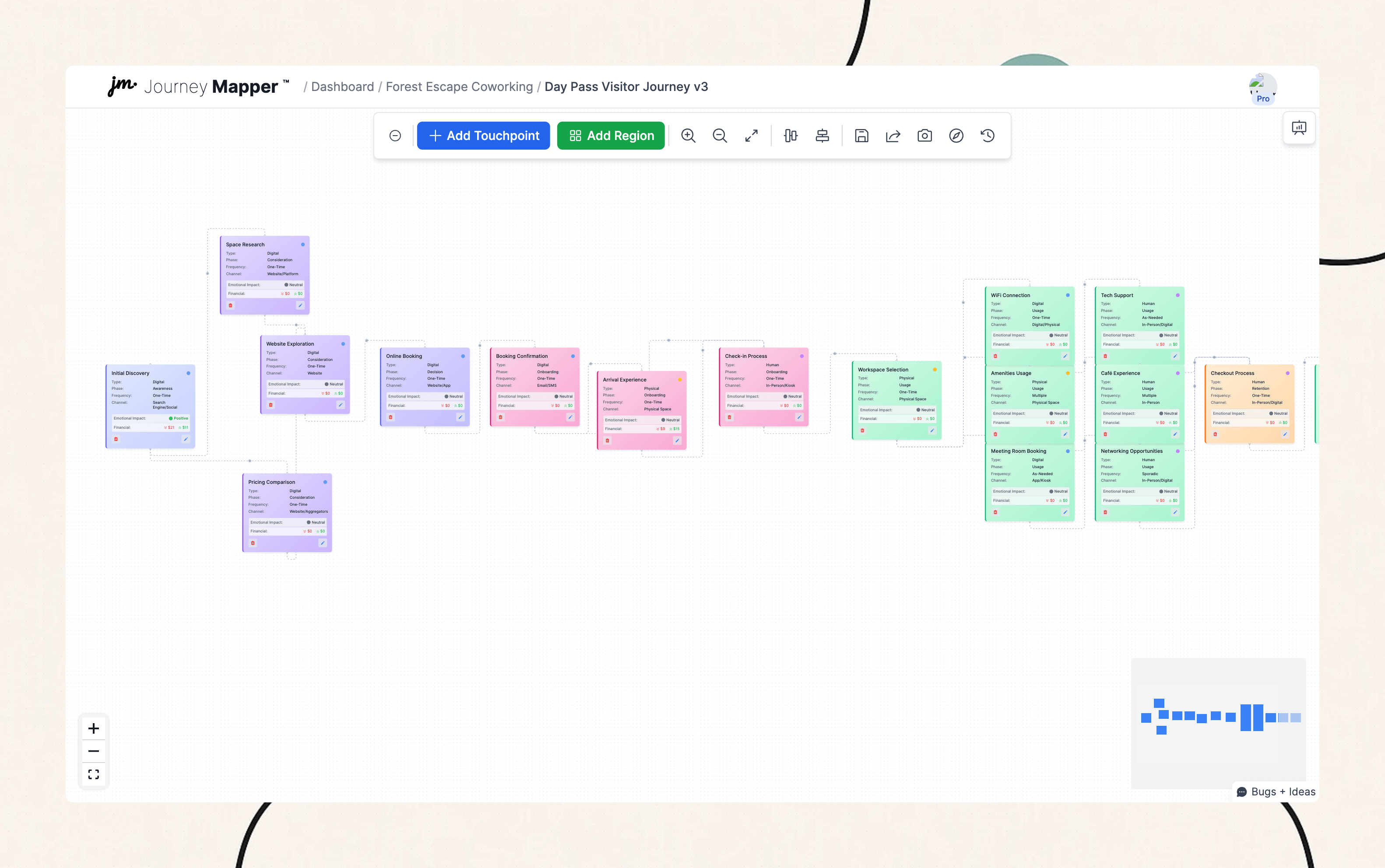
How We Built Journey Mapper to Design Better Human Experiences
How and why behind JourneyMapper.co. When you don’t have much time and keep running into the same challenges, vibe coding can be a real lifesaver. Let me show you how we turned constant problems we see through our consulting company into a tool that helps anyone who deals with real human interaction every day - and, more importantly, wants to make those interactions better.
1. The Consulting Pain That Sparked Everything
“I love my job, but time is scarce. We’re a small team and each of us does several things at once.” — Almost every coworking founder we talked to, 2023‑25
For the last three years, our tiny team has hopped all across Europe, helping coworking companies tighten up their operations. And let me write this up front: barely anyone understands how to make, read, or use NPS spreadsheets. Why would they? There’s so much jargon packed into just two words. Behind all the reasons, one thing stands out:
- Time is scarce.
- Nobody actively maps the member journey.
- Problems surface unexpectedly.
- Opportunities get missed.
- Fixes are reactive, expensive, and “feel‑based,” not data‑based.
Whiteboards, spreadsheets, Miro, sticky notes—great for workshops, useless the moment the session ends. We needed something living, collaborative, and opinionated about human touchpoints, not just flowcharts. We needed a place where the teams we work with could share collective knowledge about their customers’ active journeys, somepalce where the whole team can add input and discuss ways to improve current services or create new opportunities.
2. Scratching Our Own Itch → Journey Mapper
We do a lot of creative work on what we call Weekend Projects. We’ve formalized them under Coworkies Labs - time carved out from our weekday routines to brainstorm and build new ideas. One such weekend, we hacked together the first prototype of JourneyMapper. It was rough on the edges, but during our very first live session it quickly proved its worth. One can actively map, edit and summarize customer jounreys on a live canvas - visible to all.
That’s when the lightbulb went off:
Consultants aren’t the only ones who need this; every space that relies on real‑world interactions does.
3. What Journey Mapper Actually Does (in 60 seconds)
| ⚡ Feature | Why It Matters |
|---|---|
| Touchpoints-based canvas movable and editable | Map every step from “website visit” to “referral” without lag. |
| Data Connections that flow information | Quick visual cue and data transmission flow. |
| Real‑time multiplayer for collaboration | Founder in Bali, manager in Berlin, same canvas, zero latency. |
| AI Journeys for quick journey mock-ups | AI journeys made for testing and thinking of new opportunities. |
| Journeys templates to start fast | Templates for each industry. Made to start and itterate quicker. |
| Journey Sumamry for quick analytics | Show the financial and emotional impact of full journeys and specific touchpoints. |
4. From Coworking to… Everything Else With Doors
Human interactions are not just in Coworking. They happen in every store, museum, theater, or any other phisical space where people interact wirh a products or a services.
- Coliving houses (guest onboarding & community rituals)
- Boutique hotels / Airbnbs (self‑check‑in flows, upsells, housekeeping loops)
- Museums & galleries (exhibit path + gift‑shop conversion)
- Gym franchises (trial session → membership renewal)
- Universities (applicant funnel → alumni donations)
The pattern is the same: any place where humans move through physical space while interacting with staff or tech benefits from a living journey map.
5. Lessons
- Build for your consulting workflow first. Your difficulties are shared across industry.
- Use modern tooling AI has advanced quite a bit to provide real fast MVP prototyping a reality. Test and reiterate quicker than ever before.
- Charge early. Validate value faster than any survey.
- Pick infra that scales without ops hires. Supabase + Vercel means 99 % of DevOps is someone else’s problem.
- Opinionated UI beats generic canvases. Tentacle edges are goofy, memorable, and instantly communicate status.
- Do just enough and test Once you start it feels you cannot stop but its more important to get feedback and itterate to make the product relevat.
6. What’s Next
- Increase the marketplace of ready‑made journey templates (coworking, museum, hostel, etc.).
- Edge‑powered AI adviser that listens to live events and nudges ops managers before guests feel friction.
- More testing nothing beat a good feedback from a real customer.
If any of this resonates, whether you run a gallery or a chain of surf hostels - DM me on Linkedin. Let’s map some journeys and design better human experiences together.
TL;DR: We turned a consulting headache into a SaaS Startup that visualizes important customer journeys. Started with coworking, now touching hospitality, culture, and beyond. Entirely homegrown at TwoFifty.co, with modern, maintainable tooling.
Will update at the end of the year with how it goes with promotion and adoption. Until then happy mapping on Journey Mapper